4 Things a Solana Bot Actually Does When It Closes Trades in Minutes
Key takeaways
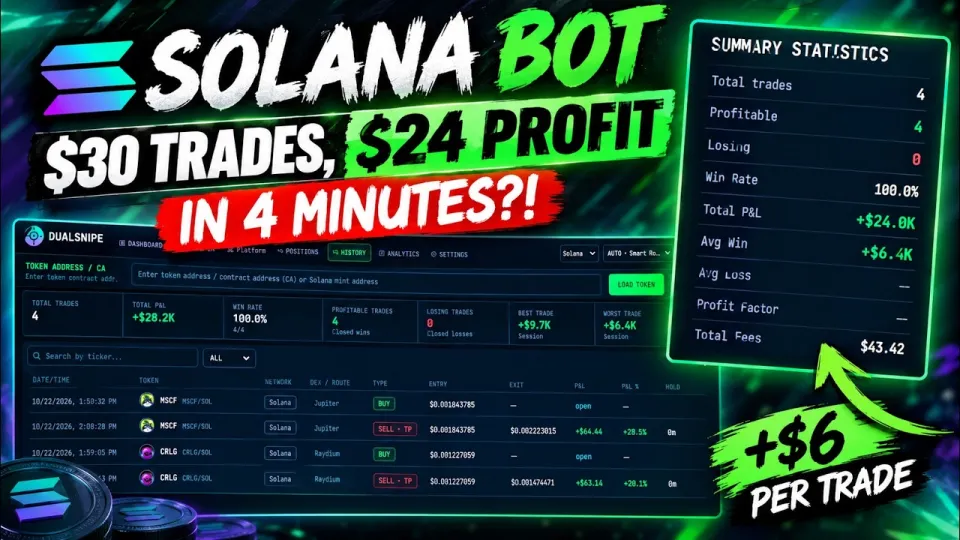
- A demo session from DualSnipe Labs shows four automated Solana trades closed in profit in roughly four minutes.
- Each trade produced about $6 profit on positions of around $30, implying a return near 20% per position before fees.
- The bot handles entries, exits and take-profit execution automatically, with live trade history and P&L tracking.
- Routing runs across multiple Solana DEXs, including Jupiter, Raydium, Meteora, Orca, Phoenix, Lifinity, OpenBook and PumpSwap.
- Past sessions are not a guarantee: crypto trading is high-risk and losses are possible.
A Solana bot is software that connects to Solana decentralized exchanges and executes trades on your behalf — scanning new tokens, placing entries, and closing positions at preset take-profit levels without you clicking through each step. In a session published by DualSnipe Labs, one such bot closed four profitable trades in roughly four minutes, averaging about $6 profit per trade on positions of around $30. The tool behind that session is available at the DualSnipe website, which hosts the product and download links.
What the four-trade session actually shows
The core claim is modest in absolute terms but large in percentage terms: four trades, about four minutes, roughly $6 gain each. On a $30 position, $6 is a 20% move before fees and slippage, which is the kind of number that only appears on very volatile, very short-horizon trades — typically new meme coins on Solana.
What the session demonstrates, step by step:
- Automated entries — the bot opens positions without manual confirmation for each trade.
- Fast exits — positions are closed within seconds to minutes rather than held.
- Take-profit execution — the exit is triggered by a predefined target, not by discretion.
- Live trade history and P&L tracking — every closed trade is logged with its result, so the session can be reviewed afterwards.
That last point matters more than the profit figure. A bot that logs entries, exits and P&L gives you something to audit; a screenshot of a green number does not.
How a Solana trading bot executes a trade
A Solana trading bot turns a signal into a signed transaction and routes it to the best available liquidity pool. On Solana this happens in seconds because the chain confirms blocks in well under a second and transaction fees are fractions of a cent, which is precisely why automated short-horizon trading is viable here in a way it is not on slower, more expensive chains.
The pipeline, in order:
- Detection. The bot watches for new token launches, liquidity additions or price movement, often drawing on data from sources like DexScreener, Birdeye or GMGN.
- Validation. Contract checks, liquidity depth and holder distribution are screened before any capital is committed.
- Routing. The swap is sent through an aggregator or directly to a DEX — Jupiter, Raydium, Meteora, Orca, Phoenix, Lifinity, OpenBook or PumpSwap are the common venues.
- Execution. Slippage tolerance, priority fee and position size are set in advance; the bot signs and submits.
- Exit. A take-profit, stop-loss or trailing condition closes the position, and the result is written to the trade log.
Every one of those steps is a parameter. The difference between a bot that produces a four-minute winning streak and one that drains a wallet is usually position sizing and exit discipline, not the routing engine.
Where sniper bots and DEX routing overlap
A Solana sniper bot is a specialised case of a trading bot: it targets the first seconds of a token's liquidity, buying before the broader market can react. Sniper bots and general DEX bots share the same plumbing — wallet connection, transaction construction, priority fees — but differ in what they optimise for.
Sniper bots optimise for speed and block position. They typically need:
- a dedicated RPC endpoint rather than a public one, to avoid rate limits and stale data;
- aggressive priority fees, which on Solana are paid per compute unit and can exceed the trade's base fee many times over;
- pre-signed transaction templates so that only the token address and amount change at execution time.
General DEX bots, by contrast, optimise for routing quality and execution price across venues. A tool that combines both — scanning new launches and routing exits across multiple DEXs — is what most retail users mean when they search for a Solana bot in 2026.
The real risks behind a four-minute winning run
Four winners in four minutes is a selected sample, and the arithmetic of small-cap trading punishes anyone who treats it as a baseline. A 20% gain per position cuts both ways: the same volatility that produces $6 on $30 can produce a $20 loss on the next entry, and on new Solana tokens liquidity can vanish between the quote and the fill.
Concrete risks to price in:
- Slippage and MEV. Fast entries on thin pools are exactly where sandwich attacks and front-running live; a bot without protection can pay more than the quoted price.
- Rug pulls and honeypots. A token can be sellable in the bot's simulation and unsellable in reality if the contract restricts transfers.
- Fee drag. Priority fees, aggregator fees and swap fees compound quickly when you trade every few minutes.
- Survivorship bias. Published sessions show the runs that worked; the losing sequences rarely make the highlight reel.
The honest framing is that a bot removes hesitation and execution delay, not risk. Position sizing, a hard stop and a limit on the number of concurrent positions do more for the outcome than any speed advantage.
Questions traders ask before running a bot
The most common doubts around Solana bots are about custody, cost and whether results are reproducible — and they are reasonable doubts. A bot that holds your keys is a different risk category from one that signs locally, and a bot that charges a percentage of profit behaves very differently from a flat subscription when the market turns.
Practical checks before depositing anything:
- Confirm where private keys are stored and whether the bot can withdraw without your confirmation.
- Test with a small bankroll and a fixed maximum position size for at least a week.
- Compare the bot's reported P&L against the actual on-chain transaction history for the same wallet.
- Check which DEXs and aggregators it routes through and whether you can set slippage manually.
- Verify that take-profit and stop-loss are enforced by the software, not by you watching the screen.
If a tool cannot answer the custody and P&L questions clearly, the speed advantage is irrelevant.
DualSnipe links and access points
DualSnipe Labs distributes its bot through three entry points, each aimed at a different workflow. The desktop terminal is the option for users who want a full trading interface; the Telegram web app suits mobile execution.
- Website and product overview: https://dualsnipe.com/
- Desktop trading terminal download: https://dualsnipe.com/api/download
- DualDex web app on Telegram: https://t.me/dualdexbot
Bottom line
A Solana bot automates the mechanics of trading — scanning, routing, entering and exiting — and the DualSnipe Labs session shows that pipeline closing four trades in about four minutes at roughly $6 profit per $30 position. What the demo does not show is the variance: the same setup can produce a fast string of losses when liquidity is thin or a launch turns out to be a honeypot. Treat the four-minute run as a demonstration of execution speed and logging, not as an expected return, and size positions so that a bad sequence is survivable. If you want to inspect the tooling behind the session, start at dualsnipe.com and test with a small bankroll first.
Questions & answers
Can a Solana bot really close four profitable trades in four minutes?
It can, and the DualSnipe Labs session shows exactly that: four trades closed at roughly $6 profit each on positions of about $30. The caveat is that this is one selected session on highly volatile tokens, where a 20% move in either direction is normal. Expect similar-sized losses on other runs.
How much capital do I need to start with a Solana trading bot?
The demo used positions of around $30, which is a reasonable minimum for testing because Solana fees are low, but you also need SOL set aside for priority fees and transaction costs. A practical approach is to fund a separate wallet with an amount you can lose entirely and cap each position at a small fixed percentage of it.
Is a Solana sniper bot the same as a Solana trading bot?
Not quite. A sniper bot targets the first seconds of a token's liquidity and optimises for speed and block position, while a general trading bot focuses on routing quality, entries and take-profit exits across DEXs like Jupiter, Raydium and Orca. Many tools, including the one shown, combine both functions.
What are the main risks of automated Solana trading?
Slippage on thin pools, MEV sandwiching, honeypot contracts that cannot be sold, and fee drag from trading every few minutes are the biggest ones. Custody is the other: check whether the bot stores your keys or signs locally before you deposit anything.
Source: Solana Bot: 4 Winning Trades in 4 Minutes?! · Markdown version